Exterior foundation waterproofing seals the Topeka wall itself but requires full-height excavation; interior perimeter drainage runs $2,500–$8,000 and manages water at the footing. With 36 inches of rain a year, most occupied basements here get interior drainage plus corrected grading.
What each does, where each fails, and how a foundation repair scope changes the answer.
Two different jobs that share a name
Exterior waterproofing is a barrier: excavate to the footing, clean the wall, apply membrane, add or replace the footing drain, backfill. Water never enters the wall. It’s the textbook answer — and the textbook assumes the wall is reachable, which on an occupied house means destroying and rebuilding everything along it.
Interior water management concedes that water reaches the footing and removes it there: a perimeter drain channel beneath the slab edge, feeding a sealed sump that discharges away from the house. The wall still sees soil moisture; your floor stays dry. It installs from inside in days, in any season, under a finished basement’s worth of belongings.
Side by side
| Exterior membrane | Interior drainage | |
|---|---|---|
| What it does | Stops water at the outside face | Collects and removes water at the footing |
| Typical Topeka cost | Priced per wall; excavation dominates | $2,500–$8,000 full perimeter |
| Disruption | Full-depth excavation, landscaping and walks out | Interior work at the slab edge, days not weeks |
| Freeze-thaw exposure | Coatings work against resettling backfill | Below frost, unaffected |
| Best moment | Wall already open: new build, addition, wall repair dig | Occupied house, finished basement, active seepage |
| Hydrostatic pressure | Blocks entry; pressure remains on wall | Relieves it at the footing — the pressure has somewhere to go |
Where waterproofing meets foundation repair in Topeka
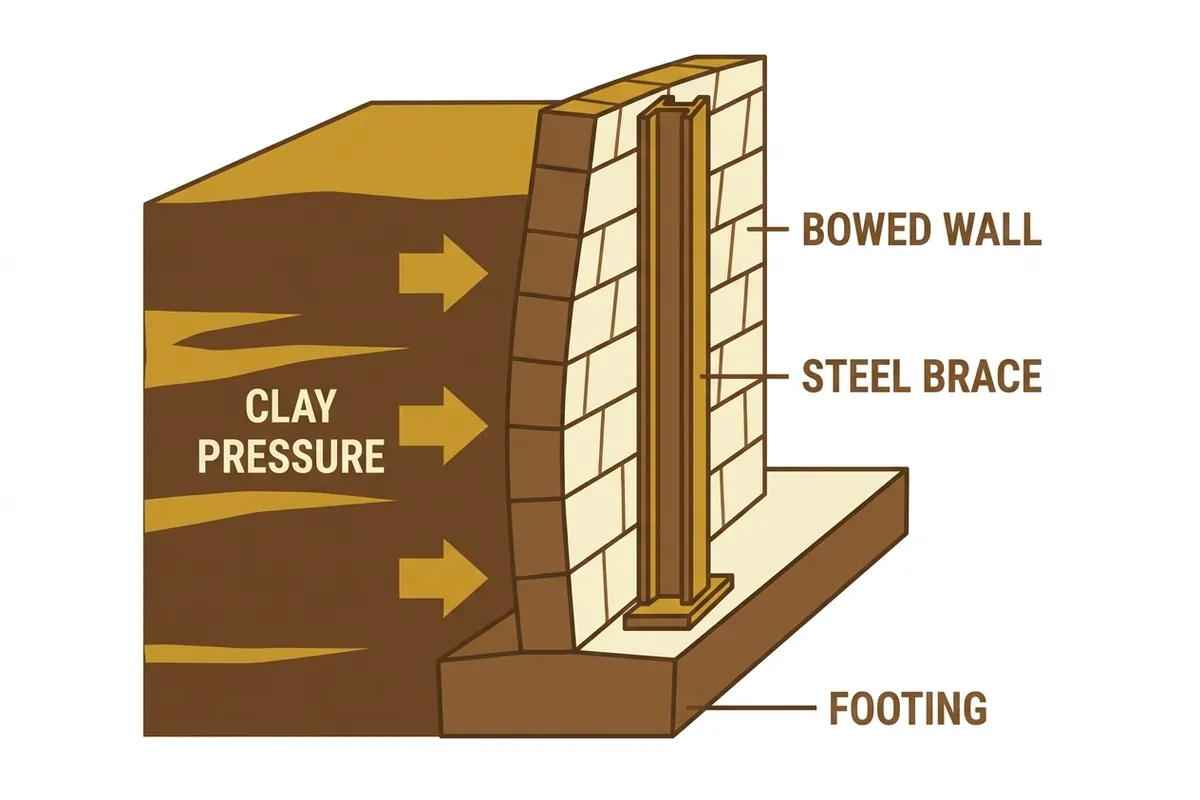
Full basements are the standard here, which raises the stakes: eight feet of wall below grade, wet springs that load the clay against it, and a finished rec room on the other side. The hydrostatic point in that table matters on our soil — saturated clay pushes on a wall whether or not water gets through it, and an interior drain gives that water a destination, which is part of why it pairs naturally with bowing wall repair when a wall is taking clay pressure as well as moisture. The rest of the drainage mechanics — sumps, discharge runs, backup pumps — live on our basement waterproofing page.
And before either system: gutters, downspouts, grading. Concentrated roof water is the cheapest problem to create and the cheapest to fix, and it drives both seepage and the settlement cycle. Every evaluation we run starts outside at the downspouts, because sometimes that’s where the whole story is. The cost guide prices all of it side by side.
What the system needs from you afterward
Interior drainage is machinery and deserves a service interval. Twice a year, pour a five-gallon bucket into the sump pit and confirm the float lifts and the pump actually discharges; that one test catches most failures before water does. Follow the discharge line outside and make sure it still carries water well away from the wall instead of returning it to the soil you just drained. Before the first hard freeze, check that the line can’t ice shut — a frozen discharge is how a working pump floods a Topeka basement in a single cold night. Then the free half of the system: clean gutters, extended downspouts, and grade that falls away from the house for the first ten feet.
Waterproofing questions, straight answers
Which is better for an existing Topeka basement?
Usually interior drainage, honestly. Exterior waterproofing means excavating the full wall height around an occupied house — through landscaping, walks, decks, and sometimes a neighbor's patience. Interior perimeter drain plus a sealed sump manages the same water for $2,500 to $8,000 without touching the yard, and it can be installed in any season.
Does interior drainage actually waterproof the wall?
No — and that's the honest distinction. Interior systems collect water at the footing and remove it before it reaches your floor; the wall itself still sees moisture. Exterior membranes stop water at the outside face. For a finished basement in this climate, managed-and-dry usually beats sealed-but-excavated, but the wall-side truth matters when comparing bids.
When is exterior the right call?
When the wall is already open — new construction, an addition, or a dig that's happening anyway for a bowing-wall repair. Also when one localized wall section leaks through a defect a membrane patch can fix without a full perimeter. Excavating an entire occupied perimeter solely for waterproofing is rarely the proportionate answer here.
What about the freeze-thaw cycle?
It works against exterior coatings. Kansas winters cycle repeatedly through freeze and thaw, and backfilled excavation soil resettles and re-cracks brittle coatings within a few seasons. Quality membranes tolerate it better than sprayed tar, but the cycle is one more reason the managed-water approach wears well in this climate.
What should I try before either one?
The free fixes, seriously: extend downspouts six feet or more, regrade soil to fall away from the wall, and keep gutters clear through the spring rains. A share of wet Topeka basements are downspout problems wearing a waterproofing costume. We check drainage first at every evaluation — sometimes the honest scope is a $40 downspout extension.
What part of this can I do myself?
The cheapest part, usually, and often the highest-return. Extending downspouts, clearing gutters, and correcting the first ten feet of grade are homeowner work, and on plenty of houses they solve the problem outright — we would rather tell you that than sell you a system. What is not DIY is anything needing excavation, a footing-level drain, or a sump tied into plumbing and electrical.
Get a free Topeka foundation evaluation
Tell us what the house is doing — a basement wall leaning in, stair-step cracks, doors that stick every August, sloping floors — and we’ll schedule an evaluation with photos, wall measurements, and floor elevations. We reply the same business day.