Topeka Foundation Co. serves Topeka plus Lawrence, Silver Lake, Rossville, Auburn, Carbondale, Osage City, Holton, Perry, and Meriden — free measured evaluations across all of them, with travel quoted honestly rather than hidden in the line items.
LawrenceSilver LakeRossvilleAuburnCarbondaleOsage CityHoltonPerryMeriden
Every town we cover, and what changes there
Each of these has its own page, because the ground and the housing stock are not the same across the region. The short version:
Lawrence — Built on a ridge, which changes everything
Lawrence is the least flat community we serve, and slope is the dominant foundation variable here. Read what that means for a Lawrence property.
Silver Lake — River-laid ground varies more than it looks
Silver Lake sits on the Kansas River valley floor, on alluvium the river deposited over thousands of years — and alluvium is not one material. Read what that means for a Silver Lake property.
Rossville — Farm ground, and the drainage that came with it
Rossville sits in the same Kansas River valley corridor as Silver Lake, in country that has been worked agriculturally for well over a century. Read what that means for a Rossville property.
Auburn — The transition zone, and why it changes pier depth
Head southwest from Topeka and the ground begins to change. Read what that means for an Auburn property.
Carbondale — The name is the geology lesson
Carbondale is named for coal, and Osage County's coal field was worked for decades — which makes this the part of our service area where knowing the land's history genuinely changes an evaluation. Read what that means for a Carbondale property.
Osage City — A working town, and buildings that show it
Osage City grew as a coal and railroad town, and much of its building stock dates from that working era. Read what that means for an Osage City property.
Holton — North of the river is the glaciated part of Kansas
Here is the fact that separates Holton from everything south of Topeka: northeast Kansas is the only glaciated part of the state. Read what that means for a Holton property.
Perry — Reservoir country with genuine terrain
Perry sits in Jefferson County near Perry Lake, the Corps of Engineers reservoir on the Delaware River, and this is noticeably more varied terrain than the flat Kaw valley to the south. Read what that means for a Perry property.
Meriden — Deep soil, and what that costs at the pier
Meriden sits in the glaciated northeast, on the same till-and-loess column that runs across Jefferson County. Read what that means for a Meriden property.
Three kinds of ground, split by the Kansas River
This service area straddles a real geological boundary, and it shows up in every estimate. North and east of the Kansas River — Holton, Perry, Meriden — is the glaciated part of Kansas, the only part the ice reached. Deep glacial till and thick loess mean piers may travel a long way to find bearing, and loess brings its own failure mode: it can collapse when thoroughly saturated, so concentrated water is a settlement risk rather than a nuisance. South and west — Auburn, Carbondale, Osage City — was never glaciated. The Osage Cuestas put limestone and shale close to the surface, so piers refuse sooner and cost less, while a thinner soil column delivers the moisture cycle to footings with less to buffer it. In the valley — Silver Lake, Rossville — river-laid alluvium varies over short distances beneath ground that looks table-flat, with a water table closer to the surface. Lawrence adds real terrain and an 1850s core.
That variation is why we never quote a standard pier depth across this region. Each page above reads its own ground — and the evaluation reads your specific lot.
Basements everywhere, and that's the constant
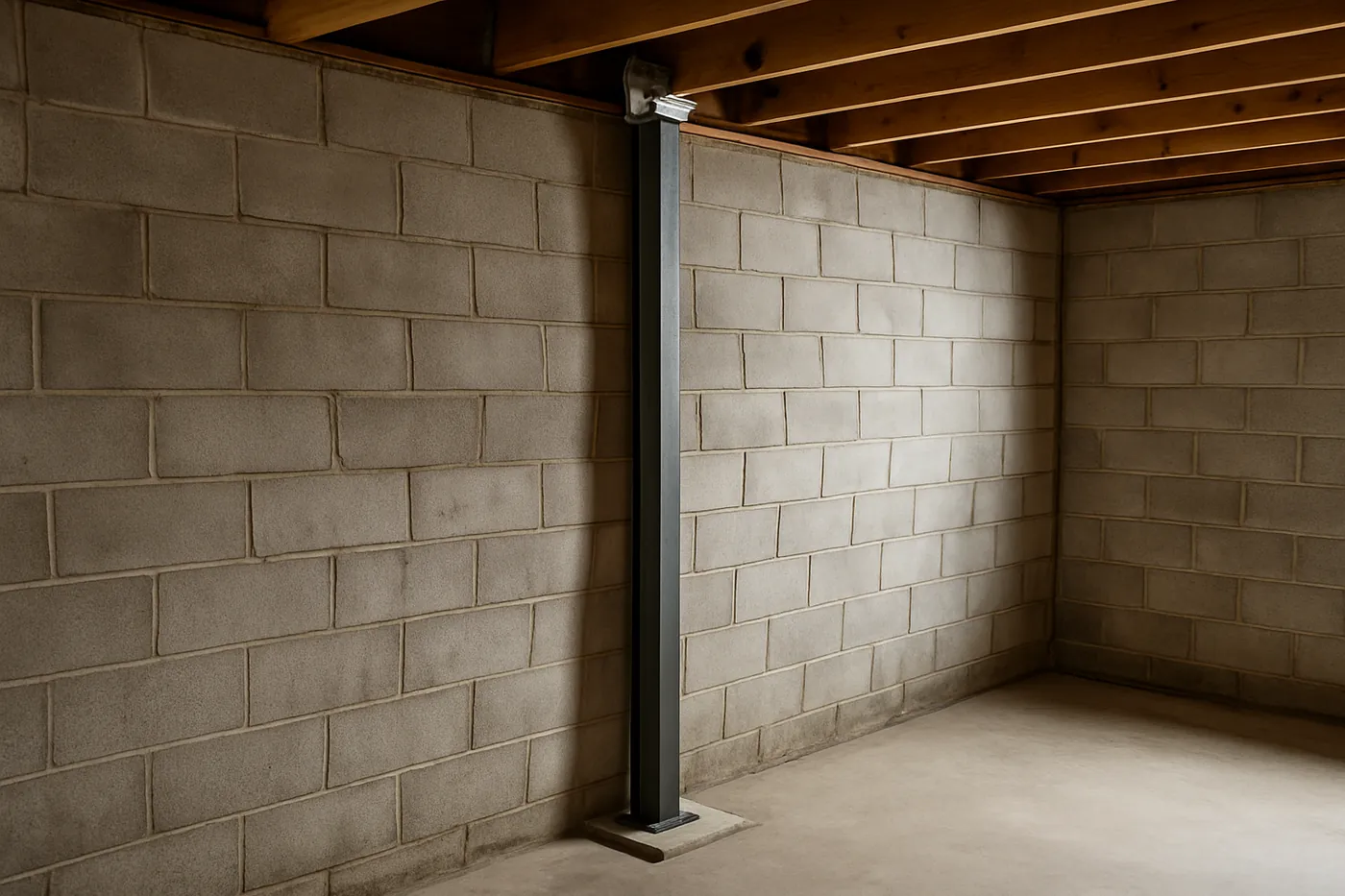
Across all ten communities the same fact holds: full basements are the norm here, which is why inward wall movement is this market's signature failure rather than the slab cracking that dominates warmer clay regions. What differs is the soil column behind the wall and how far a pier must travel beneath the footing — and those two variables are most of the difference between a $4,000 job and a $15,000 one.
Somewhere between towns, or just outside this list? Ask — regional travel gets quoted honestly.
What it means when we say we cover a town
It means the free measured evaluation happens at your address on the same terms it would in Topeka — the same laser floor survey and crack measurements, the same written scope afterwards, and travel quoted as its own line rather than buried inside the others. If a job is far enough out that travel is material, you will see that number before you agree to anything.
Foundation work is scheduled, not urgent — which means an outlying address costs you nothing in response time.
These 9 communities are where we work regularly enough to know the ground before we arrive. That is the honest boundary: not a radius drawn on a map, but the places we have looked at enough properties to recognise what we are seeing.
Do you come out this far?
Almost always, and it is worth asking rather than assuming. People call us having noticed one thing — a door that stopped latching this season, a crack that reappears after it is filled, or a floor that feels out of level near one wall — and the first question is usually whether we travel to them at all. The list above is where we work often enough to know the ground before arriving, not a boundary drawn on a map. Somewhere between two of these towns is a yes.
Coverage questions
Do you charge extra to come out to the outlying towns?
Travel is quoted as its own line when it applies, and you see it before agreeing to anything. It is never folded into the price of the work, because a scope you cannot read is a scope you cannot compare against anyone else's.
My address is not on the list. Do you still come?
Usually, and it is worth asking. The list is the area we work regularly enough to know the ground in advance, not a hard boundary. Somewhere between two of these towns is almost always a yes.
Is the visit really free, everywhere on this list?
The visit is really free, everywhere on this list, on the same terms in Lawrence as in Topeka. You get the laser floor survey and crack measurements and the written findings whether or not you go ahead, and whether or not we end up quoting the work.
Why does the price differ between towns for the same job?
Because the ground does. Each town page above explains what changes locally, and the quote follows what the visit measures at your specific address rather than an average for the region.
Get a free Topeka foundation evaluation
Tell us what the house is doing — a basement wall leaning in, stair-step cracks, doors that stick every August, sloping floors — and we’ll schedule an evaluation with photos, wall measurements, and floor elevations. We reply the same business day.